Geographical Features
Location and Boundaries
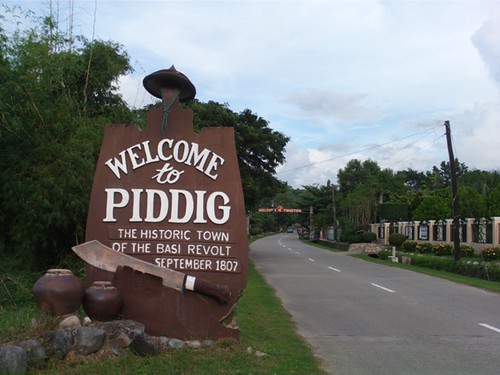
Some seven kilometers east of Laoag City, Piddig lies on a beautiful land of rolling hills against the romantic background of the Cordillera mountain ranges that border it on the northeast. Its other boundaries are Vintar on the north, Carasi on the east, Solsona on the south, and Sarrat on the west and Dingras on the southwest.
Land Area and Topography
The 23 barangays composing it are spread out through a land area of 17,043 hectares. Almost all of its surface are hilly and rugged mountain ranges which are rich in lumber, nito, rattan and cogon grass. There are two rivers that surround the area - the Guisit and Palayan rivers.
Climate
Just like any other town of the province, Piddig has its wet and dry seasons. The long dry season falls on November to April, while the wet season is on May to the early part of October. December to February are the coldest months during the year, while April is the hottest.
Town History
Establishment
The town was settled by a group of Itnegs as early as 1770. These settlers cleared the lands, tilled the soil and raised abundant food supply. A few years later, the people of San Juan, La Union and some towns of Ilocos Sur arrived in the settlement and drove the natives away. The Itnegs fled to the mountains called Anayan and to some other places. As the semi-civilized settlers increased in number, they intermarried with the people of the neighboring towns.
Origin of Its Name
When the settlers increased in number, they founded the town and called it Pidipid, an Ilocano term which signifies a hilly place. Later on, when the Americans arrived in the country and reached the place, they changed the name Pidipid to Piddig, because the hilly place is situated at the foot of the mountains.
Religious History
The people are religious and God-fearing. Many religious sects were established. The Roman Catholic Church pioneered in the town. Augustinian missionaries began the Christianization of the people. Fr. Manuel Madriaga was the first resident priest. The people were easily converted to Christianity as a result of the great zeal of the missionaries.
In 1902 a new sect was organized by Monsignor Gregorio Aglipay, with the cooperation of Rev. Jose Castro, who became the first priest of tbe Philip-pine Independent Church in Piddig. Almost all of the people of the town pledged their faith and became followers of the new sect.
The Protestant church was established in the town in 1905 by an American Misaionary, Mr. William H. Hanna The first minister was Rev. Esteban Salomon,who carried on the ministry with considerable success.
Places to See
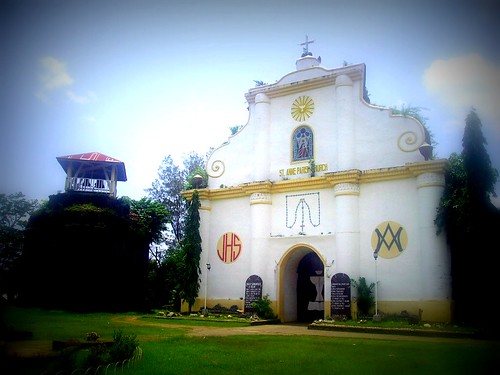 |
· The Baroque-style Church of St. Anne, built atop a moderately elevated hill, has a grand stone stairway from the church to the plaza. During the Philippine-American War, it was occupied by a 5-man Filipino guerilla team who repulsed early American attacks. The church was repaired after the March 19, 1932 earthquake toppled the upper level of the bell tower. During World War II, it was occupied by American forces. The convent, sacristy as well as parochial records, furniture and statues were burned when Japanese forces raided the town. In 1965, the facade and interior of the church was restored. The convent, with its series of arcades, was repaired and converted into a parochial school.The courtyard, enclosed by a stone and brick fence, rises above two lower squares that flank it. Inside the church are the original wooden pulpit and five Neo-Classic retablos of brick and lime. The central retablo houses the image of St. Anne supporting Mary on her lap.
·
|
Brief History
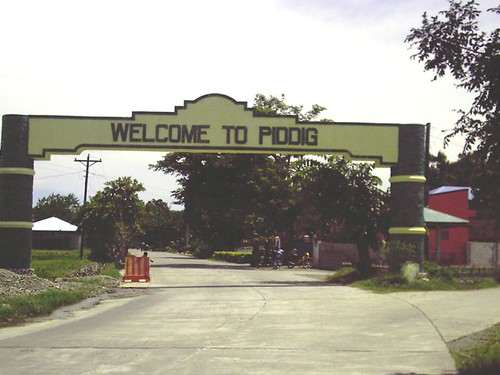 |
· Piddig was founded in 1732 as a visita of Dingras
· It became an independent parish in 1770.
· The town's name was probably derived from the word pidpideg meaning “corners” due to the first settlers having built their huts on the slopes of mountains. It was changed to its present name upon the arrival of the Americans.
ADDITIONAL READING:
Excerpt from:
THE ROAD TO ALMAGUER: FLEEING PIDDIG, HAVEN IN BAYOMBONG
http://bigberto.blogspot.com/2006/07/road-to-almaguer-fleeing-piddig-haven.html
. ...Enticed by his cousin Miguel, Lakay Burik decided to migrate to Nueva Vizcaya at around the first decade of the 1900s and settled in a place called Piddigan (later renamed La Torre in honor of the Spanish Governor Ramos de la Torre). Piddigan or La Torre is part of Bayombong that was established as a pueblo in 1739 by the Augustinians. It was, however, a Dominican --- Fr. Juan Crespo --- who started building the present church in 1773 that now serves as the diocesian cathedral and dedicated to Santo Domingo. Only the façade and the bell tower were left of the original structure.
Piddigan was so called because its first settlers were from Piddig, Ilocos Norte. According to family historians from my mother’s side, Miguel Castrovierde Tomas and his brothers killed the cruel Spanish priest of Piddig by stabbing him with a puyod. They then fled to Nueva Vizcaya, founded the barrio of Piddigan, and changed their names into Castros, Vierdes/Verdes, and Tomases. Miguel and his brothers became the Tomas branch. When the Americans invaded, they went back to Piddig to fetch their relatives to join them in Piddigan. That is how their first cousin Lakay Burik joined them.
I visited the church of Piddig (dedicated to Sta. Ana) on the same day I visited Dingras in 17 June 2005. In Dingras, I tried to commune with the spirits of my ancestors. In Piddig, I lighted a candle to hail the bravery of Miguel and his brothers and ask forgiveness for their deed. There are no records on when and who built the church but it is believed to be one of the earliest churches in the province of Ilocos Norte. It served as the headquarters of Filipino revolutionaries during the Filipino-American War, and by American forces during World War II. Piddig is also rich in local history: it was its conscripted skilled Tingguian archers who captured Gabriela Silang in 1762 and was the center of the 1806-1807 Basi Revolt led by Pedro Mateo and Salarogo Ambaristo. Its first Filipino parish priest, Fr. Jose Castro, became the country’s first Aglipayan priest when the Augustinians fled in the aftermath of the Filipino-Spanish War. Piddig is also the birthplace of Claro Caluya --- the “prince of Ilocano poets”, and Sgt. Teofilo Ildefonso --- the country’s only double Olympic bronze medalist.
Miguel did not stay long in Piddigan. At around 1906, he and some settlers relocated in a place near Bantay Sabon --- a forested area they passed along the dacquel nga carayan on their way to Piddigan where pure water bubbles from a spring that feeds into a creek with eels as big as a man’s leg. Lakay Burik again joined his cousin in this place where he cleared his dappat and raised his family. It is called Almaguer.
|


